


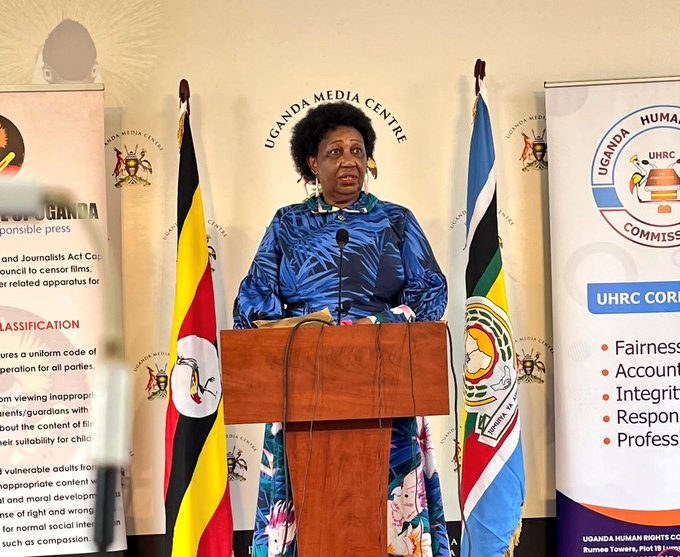
The Uganda Human Rights Commission has given the green light to the 2026 presidential elections but not without raising red flags. UHRC Chairperson Mariam Wangadya while addressing journalists on Sunday says the elections were free, fair and credible, allowing Ugandans to vote peacefully despite technical and rights-related challenges. “The election climate and security deployment fostered […]

The Uganda Human Rights Commission has given the green light to the 2026 presidential elections but not without raising red flags.
UHRC Chairperson Mariam Wangadya while addressing journalists on Sunday says the elections were free, fair and credible, allowing Ugandans to vote peacefully despite technical and rights-related challenges.
“The election climate and security deployment fostered a peaceful electoral process that was largely free and fair,” Wangadya said.
Wangadya dismissed claims that the election results were not authentic, saying the commission had no reason to doubt the declared outcome.
“I do not have any reason to doubt the authenticity of those results,” she said.
She added that candidates who doubt the results should pursue legal channels.
“Any candidate who doubts the authenticity of those results can petition court to have them verified as provided by the law,” she said.
She added that the results announced at polling stations were properly documented. “There is no concrete reason why the Electoral Commission should not endorse the elections,” she said.
According to the Commission, voting across the country was largely calm, even where materials arrived late.
“Voters arrived as early as 6:30 a.m. and remained calm despite delays,” Wangadya said.
However, turnout dropped sharply. Only 11.36 million voters cast ballots out of 21.6 million registered voters, translating into 52.5 per cent turnout, down from 59.35 per cent in 2021.
Urban areas, especially Kampala and Wakiso, recorded the lowest participation.
The UHRC raised concern over the performance of biometric voter verification kits, saying they worked properly at only a few polling stations. In some areas, including Yumbe and Wakiso, the kits never arrived.
At 9:30 a.m., the Electoral Commission ordered officials to switch to manual registers.
“The extension of voting time was welcome, but the communication came too late for some presiding officers,” Wangadya said.
The Commission criticised the January 13 internet shutdown, saying it affected about 17 million users.
“The restriction limited access to information and freedoms of expression and association,” Wangadya said. The shutdown also disrupted mobile money, especially in rural areas.
She however said if the greater need to turn off the internet superseded individual wants, then it was worth it. Wangadya further asked aggrieved individuals to file complaints where need be.
“The losses are regrettable and if the suspension of internet was informed by the public good, again let the public good prevail,” she said.
While voting was generally peaceful, incidents of violence were reported in several districts.
Media reports cited seven deaths, three gunshot injuries and 25 arrests, mainly in Butambala and Kalungu.
Despite the challenges, the UHRC concluded that Ugandans voted in a largely peaceful environment.
President Yoweri Museveni secured a commanding 71.6 per cent victory, defeating seven rivals.
His closest challenger, NUP leader Robert Kyagulanyi, polled 24.5 per cent.
UHRC recommended that the Electoral Commission : Test electoral technology thoroughly before polling day, Invest more in voter education, Allow agents to verify voters manually where digital systems fail
The UHRC says the election passed the credibility test but reforms are urgently needed before the next vote.


